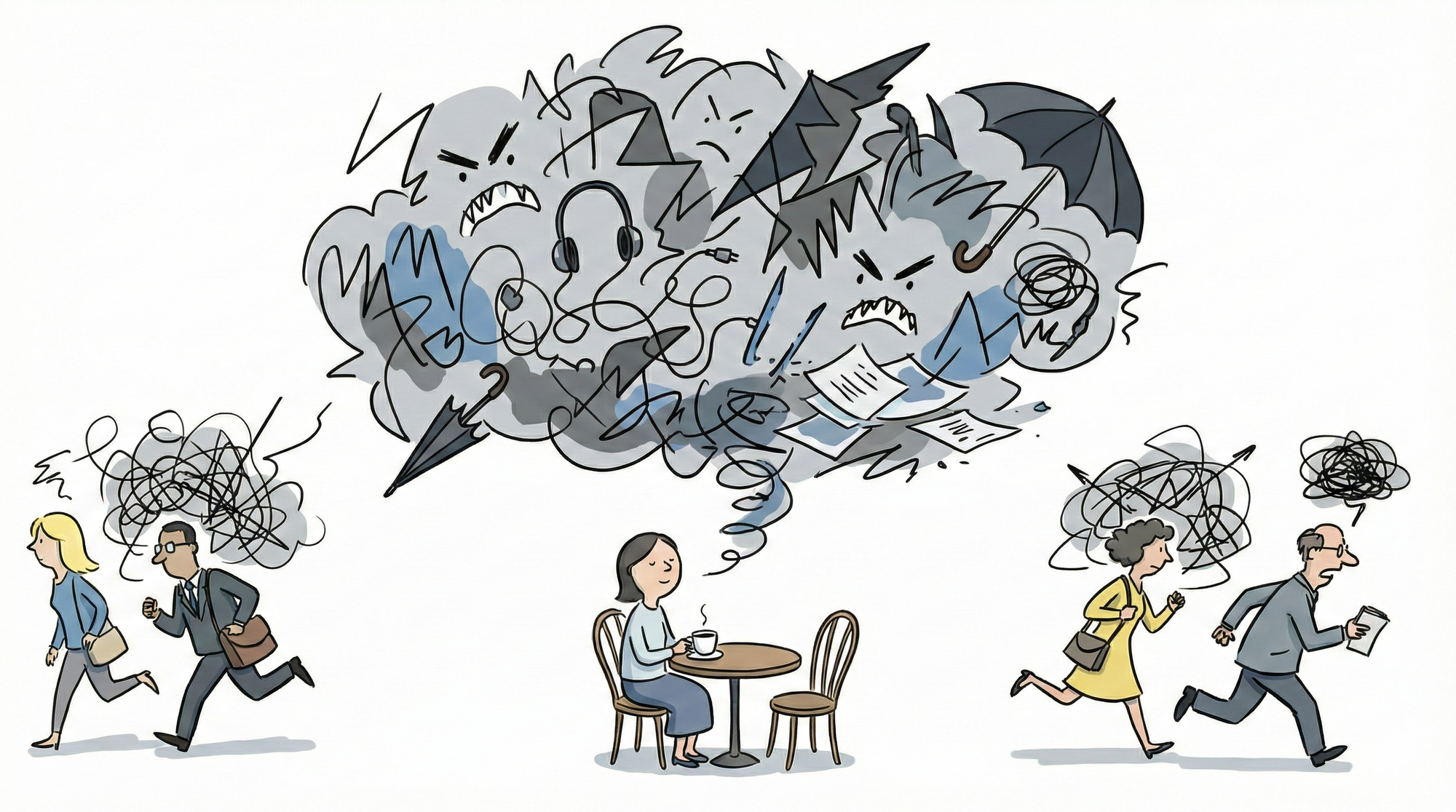
Stop Creating "Imaginary Enemies"
no one has the time to play the villain in your story.
Have you ever experienced a moment like this:
You walk into the office, and a colleague rushes past without saying hello. Your immediate reaction is: “Is he upset with me?” You send a message to your partner, and two hours pass without a reply. A drama begins to unfold in your mind: “Is he deliberately giving me the cold shoulder? Did I do something wrong?”
In these moments, our brain acts as an exceptional screenwriter. It rapidly captures clues and stitches them together into a “Victim Script.” In this script, you are the innocent protagonist, while those around you are malicious antagonists, targeting you and making your life difficult.
But if we peel back the shell of emotion and dissect these moments with a scalpel of absolute rationality, you will discover a cruel yet liberating truth:
The vast majority of malice is merely our imagination.
You Are Just an NPC in Their Script
The root of this “victim mentality” is actually a form of implicit narcissism. In psychology, this is known as the “Spotlight Effect.”
We always assume we are standing center stage, with all the lights focused on us, and that every micro-expression and action of those around us is a response to us.
But the reality is closer to this: Everyone is the absolute protagonist of their own movie, and in their movie, you are just an extra (an NPC).
- You think your colleague’s coldness is “targeting you,” but he is actually just anxious about an upcoming KPI review and didn’t even notice you standing there.
- You think your partner’s silence is “calculated” neglect, but he has actually just come out of a terrible meeting, his energy is depleted, and he just wants to hide in a cave and zone out.
Their behavior is a reaction to their own life circumstances, not an attack on you.
Once you accept the setting that “everyone is busy — busy saving themselves, busy living,” you will feel an unprecedented sense of relief: It turns out I’m not that important. And that is truly a good thing.
Not Just Stupidity, But “Entropy”
There is a famous mental model called Hanlon’s Razor:
“Never attribute to malice that which is adequately explained by stupidity.”
This is a great starting point, but we can take it a step further and view it more critically. Describing others as “stupid” still carries a hint of arrogance. A more objective explanation is: Limitation and Entropy (Disorder).
The real world is a massive, chaotic system. Information is asymmetric, and human energy is limited.
- The person “targeting” you might just possess less information than you (Ignorance).
- The person “hurting” you might just be temporarily offline in their emotional management (Incompetence).
- The person “hindering” you might just be committing a simple random error (Entropy).
When we rip off the label of “Malice” and replace it with “Randomness,” “Fatigue,” or “Misunderstanding,” hatred loses the soil it needs to grow. You can’t hate a rock that falls and hits your foot because of gravity, can you?
The Wisdom of High Latency
Japanese author Junichi Watanabe proposed the concept of “The Power of Insensitivity”. Many people mistakenly think insensitivity means being slow-witted, numb, or heartless.
No. True insensitivity is a high-level “System Latency.”
When receiving external stimuli (like a harsh comment), people with low cognition have a “direct connection”: Stimulus -> Emotional Explosion -> Counterattack
People who possess the power of insensitivity artificially create a massive buffer zone between “Stimulus” and “Reaction”: Stimulus -> (Buffer: Pause/Observe/Apply Hanlon's Razor) -> Rational Attribution -> Selective Response
In this buffer zone, you complete the filtering of information. You realize: “It is never the event itself that affects my emotions, but my interpretation of the event.”
This “dullness” is not a degradation of the senses, but an awakening of rationality. It is the absolute control over your own emotional sovereignty.
The Coldest Compassion
Finally, we need to introduce a core tool from Adlerian psychology: Separation of Tasks.
This is a required course for all independent thinkers. In this world, there are only three types of business: God’s business, other people’s business, and my business.
- How others treat me, whether they are rude, whether they have manners — this is their task.
- How I interpret this event, whether I decide to feel hurt, what I do next — this is my task.
If you feel pain because of someone else’s coldness, essentially, you have crossed the line. You are trying to maintain “your sense of security” by controlling “someone else’s attitude.” This is destined to be futile.
People with critical thinking understand: Even if the other person really does harbor malice (though the probability is extremely low), that is a flaw in their personality; it is their own private hell. I have no obligation to pay for their flaws, and certainly no obligation to punish their mistakes with my pain.
Take Back Your Remote Control
Life doesn’t hold that many carefully orchestrated conspiracies; it only holds countless busy, tired, ordinary people who occasionally make mistakes.
Next time you feel the world is targeting you, try pressing the pause button in your mind.
Tell yourself: “This is his task, not my script.”
When you no longer consume yourself in that non-existent “malice,” you will truly possess an independent and free soul. This isn’t just insensitivity; this is the highest level of control over life.